Creating an Arts & Culture Zone
Economic support of the Arts continues to be under-prioritized, inadequate, and aspirational in an environment of fierce competition with political trends and sufficient provision of human services.
The issue is not, however, that the Arts are deemed weak or unimportant to decision-making in those areas. The real issue is that, without a track record of impacts that clearly enhance those two areas in a predictably consistent way, the Arts are seen as optional except for those who will make art regardless.
The most important response to this is to explicitly account for how the presumptive "ecosystem" of the arts environmental) is actually a System (architectural).
In that way, the Arts are not seen as something that is improving some other system; rather, a system is designed such that it continually generates the productivity of art-making beyond a critical threshold of Return-On-Investment (ROI). The ROI perspective entirely displaces the Subsidy perspective as the orientation of strategic planning.
This point of view immediately calls up a recognition of what sources of money are active investors.

With that economic input, effects of the system dynamics build sustainability by being inherently regenerative:
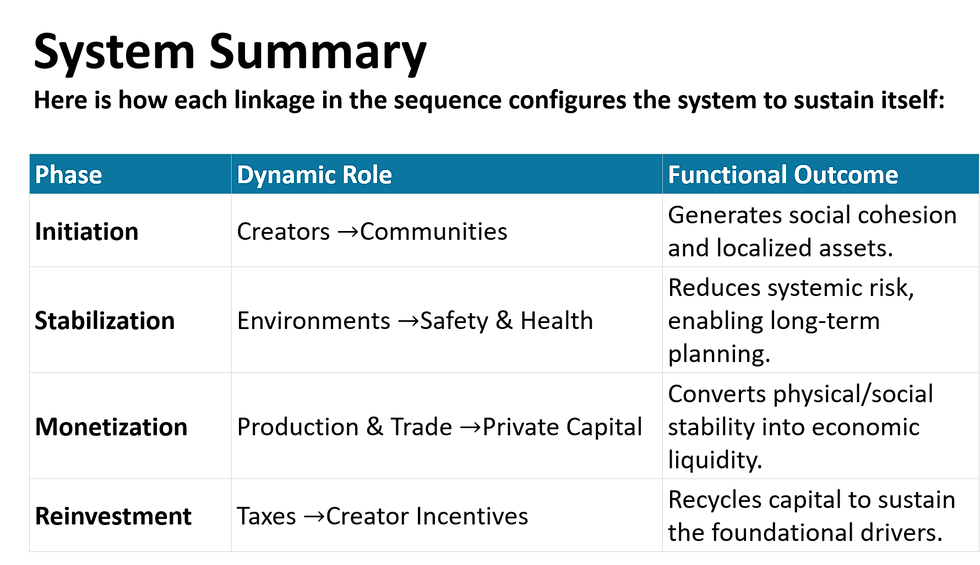
The measurable outcomes constitute the environment, and the environment fosters confidence in benefits arising from collaboration and synergies. Additionally, the system is open to more and various contributors who essentially add energy into the system without imbalancing it.
The full specification of this approach is a solution architecture, described in the following document:
Archestra Research continues to scan arts regions such as the East Bay in California for past and present examples of efforts and impacts that now logically map to the system model as dynamically effective candidate contributors.


Comments