Echoes and Rhymes: Vincent Valdez
Vincent Valdez's Historical Truth
When Vincent Valdez was approached in 2023 by Arion Press to imagine his next project, the publisher and the artist were actually continuing an ongoing conversation, one that led to his selection as Arian's first King Residency artist in residence. The project they picked for the residency? Kurt Vonnegut's meditation on the catastrophic impact of war, Slaughterhouse-Five.
The core of Valdez's oeuvre is his mission to dispel what he calls "social amnesia" - moments when we as the public become distanced from verifiable realities by an unprecedented prevalence of disinformation and cultural polarization. (Sound familiar?) We must, Valdez believes, recognize and reject that distance.
In contrast to much photography and high-fidelity representational painting, Valdez's meticulous creations in hand-drawn ink have the special quality of amplifying our awareness of his effort. His drawing registers as a speech act, a testimony that, when complete, has the force of a single clear idea. As we dwell on it and take in the details, we increasingly try to retrace his steps in getting it done.
As a result, our extended attention becomes focused concentration, and we can feel ourselves working with him on the creation of the image - said differently, of having a realization. The feeling is both like recalling a memory and making a discovery. It tells us what we might already know, but immediately compares what he sees to what we see in our minds.
The Brooklyn Rail notes that Valdez "creates images as instruments to probe the past in order to reveal an immediacy to what is occurring today, and to remark on a universal struggle within various socio-political arenas and eras."

Valdez's probing highlights the way we experience the world from multiple perspectives, sometimes reconciling the differences but not always. And when we act on life from some given perspective, we are not always ready, willing, or able to include the others. Meanwhile, the consequences of our actions are in their own way convincing. The result: truth can be illusory, but also that truth can simply be what we have not looked for hard enough or looked at hard enough. Witnesses make the difference, and Valdez is an enlightening witness.
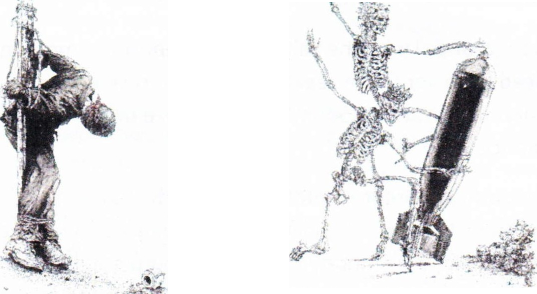
Valdez created images for Arian's edition of Slaughterhouse-Five that link Vonnegut's shifting "realities" of Billy Pilgrim's experience to Valdez's own sensibility about the challenge to the individual's sense-making effort in life. The suite of images, collectively, both review the life in Vonnegut's text and compare it to Valdez's awareness, an awareness is drawn from his own experience. The drawings explore Billy Pilgrim's fictional life from various perspectives; Valdez's drawings reiterate selected things for more of our attention, and they also comment on how we pay attention. The observation ranges variously across the imagined versus the real; the mundane versus the tragic; the intimate versus the public; the rational versus the absurd.
Published in 1969 as Slaughterhouse-Five, or, The Children's Crusade: A Duty-Dance with Death, Vonnegut's novel has enjoyed notoriety and great influence in visual media before, especially with the 1972 film version directed by George Roy Hill. Vincent Valdez's fresh achievement is in bringing its interpretation and original format fully into the present.
His interpretation is enormously enhanced by Arion’s handmade artistry. From the type to the
paper to the slipcases (including an aluminum casing in Army green for the Deluxe edition), the edition gives us a new way to experience the novel and hints at its moral clarity and enduring relevance.


Comments