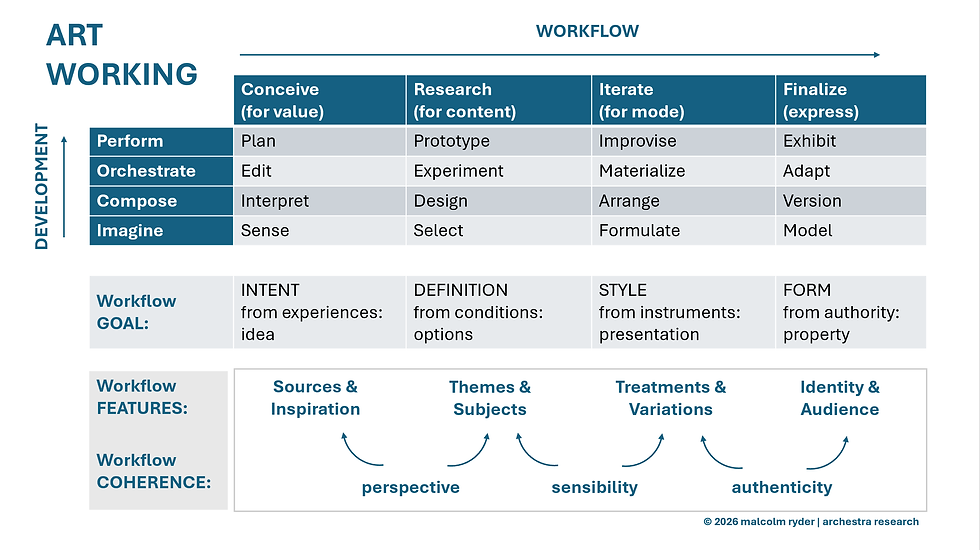
ART WORKING
The End-to-End Effort of Creative Labor
Within the generic notion of “creativity” a maker includes operator (assembler/processor), producer (enabler/developer), and of course creator (conceiver, author).
Yet while those distinctions are co-equally important to our understanding, we readily observe that in action they have a lot of things in common.
Recently, creativity has again been forced into new reckoning by the evolution of technology. Now, AI extends the arc mapped at least by the camera, the audio synthesizer, and computer graphics.
Those developments each called into question the distinction between tools as machines and tools as instruments.
We also long ago accepted that machine automations can produce both desirable and undesirable products and can occupy the role of “operator”.
But we rarely if ever cast them in the role of “creator” because we attribute to them no autonomous “intent”.
There is no question that all three roles do work that generates a known output (thing) and outcome (condition).
But seen as what they respectively bring to work, each role has responsibilities that exist outside of the “Creator”.
All the major ingredients of autonomous intent – motive, decisions, purpose – remain part of our specific distinguishing definition of creator.
Meanwhile, the Creator role is fundamentally the same across the wide range of disciplines and mediums.
It is a distinctive way of making, both philosophically and practically.
As art-making, the work in the role (“vision” and “execution”) is based throughout the effort in aesthetic decisions.
Aesthetics - the principles governing the creation, expression, and appreciation, of sensory perception, including how individuals interpret, value, and emotionally engage with such forms as experience.








Comments